
Periodontitis Treatment
Stem-cell approaches are being studied as an added regenerative option for selected periodontal defects, not as a replacement for standard disease control. A 2026 meta-analysis of 10 clinical trials found modest average improvements in probing depth and clinical attachment compared with control treatment, while also noting study differences and the need for larger rigorous trials.[1]
We provide information and coordination support — we’re not your dentist. Diagnosis, treatment decisions and clinical care stay with qualified professionals who have your full records in front of them.
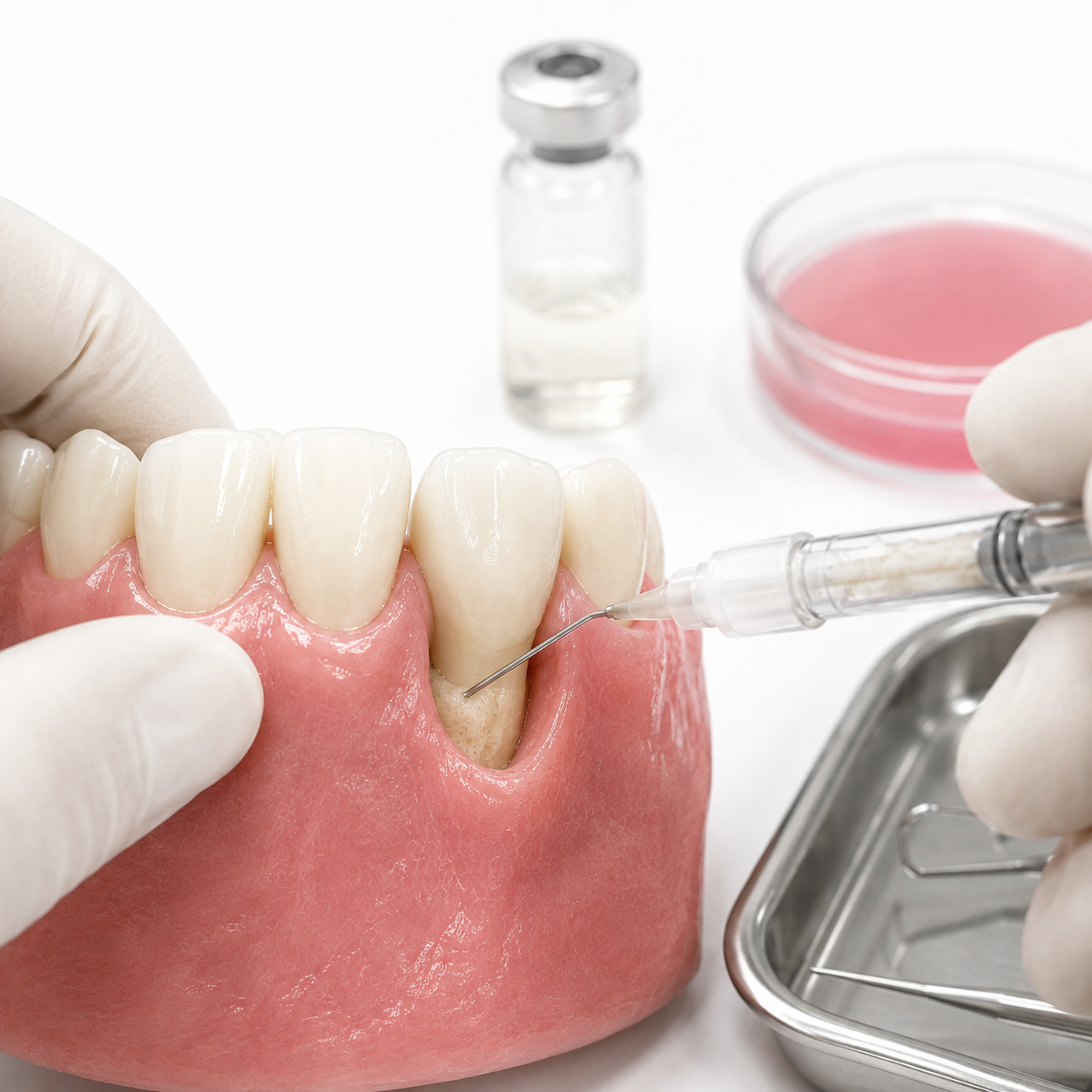
The average benefit is measurable, but it is not a guaranteed regeneration result.
Across 10 human clinical trials, mesenchymal stem-cell approaches produced modest but statistically significant improvements in several periodontal measures compared with controls.[1]
The review did not find a statistically significant improvement in gingival recession (MD −0.18 mm; 95% CI −0.38 to 0.01; p=0.07; I²=0%). The authors rated the evidence high-to-moderate with GRADE, but the limited number of studies and heterogeneity still require cautious interpretation. These data do not prove complete bone restoration, one best cell source, or a long-term tooth-survival advantage.[1]
Suitability starts with the periodontal defect and disease control, not the word “stem cell.”
The published studies are most useful when your actual defect, baseline measurements and proposed protocol can be compared with the study population.
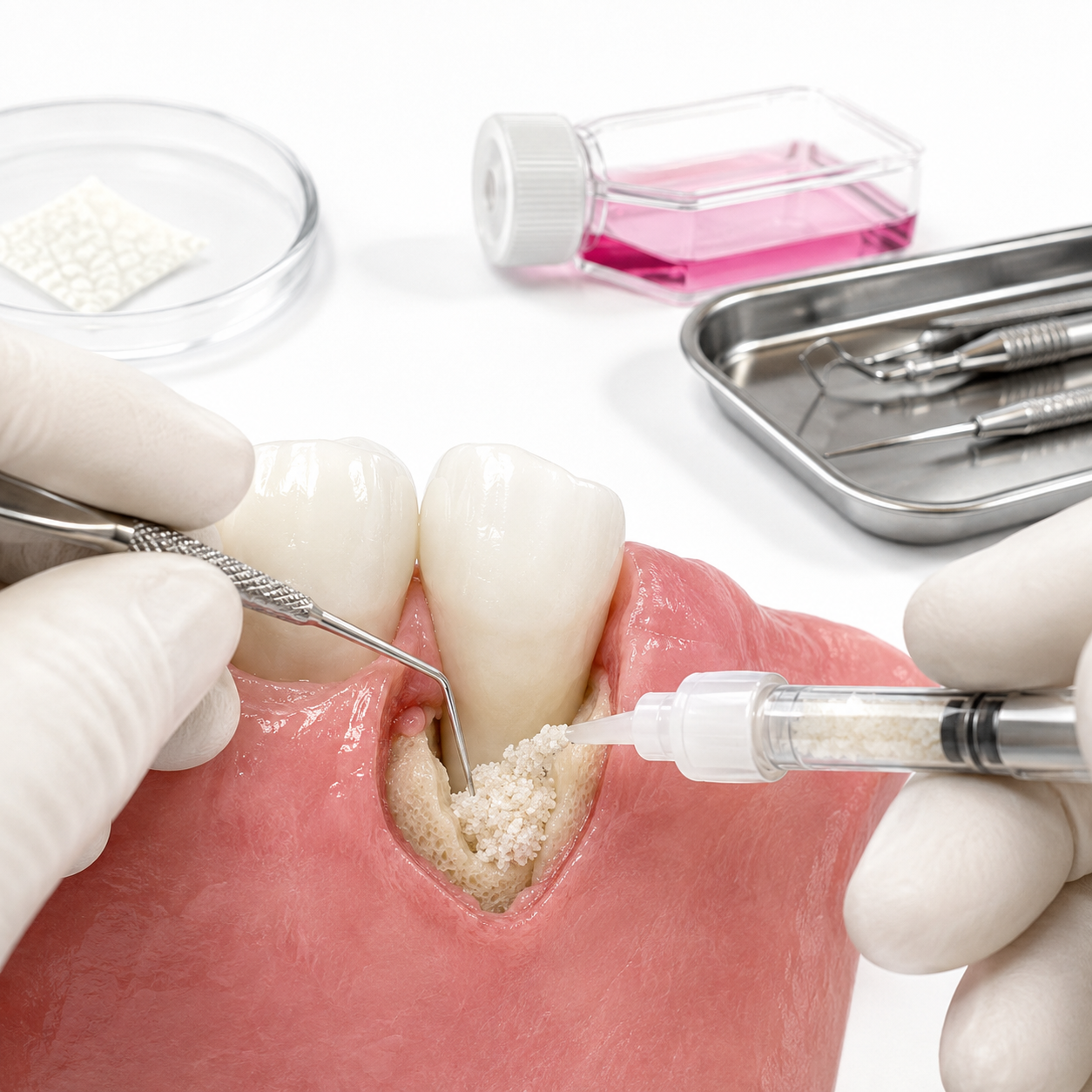
Participants were 18–65 years old with chronic periodontitis and probing depths of 4–8 mm. The trial excluded people with conditions including diabetes, cancer, heart disease or systemic infection, and current smokers of more than 10 cigarettes per day. These were study eligibility rules, not universal treatment contraindications. If your health profile differs, do not assume the trial result transfers directly to you.[2]
Urgent symptoms: rapidly increasing facial or mouth swelling, fever with spreading dental infection, or difficulty breathing or swallowing need urgent dental or medical assessment rather than an online review.[11]
These thresholds are more useful for your next step than a generic “stem-cell candidate” label.
The thresholds below come from the EFP treatment pathway for stage I–III periodontitis. They’ll help you see whether disease control has already reached its target or whether established regenerative surgery is on the table.[4]
Stage IV has a separate EFP guideline because tooth loss and problems with mastication can require multidisciplinary care involving periodontists and other dental specialists. Stem-cell trial results should not be used to simplify a stage IV case into a single regenerative procedure.[12]
Already have reports, images or a proposal?
Send what you have. We can help you turn it into a short list of questions and comparison points.
Dental-pulp stem-cell injection showed a signal in selected stage III periodontitis, not across every patient subgroup.
The study included 132 patients and 158 teeth at two centers. Periodontal infection was first managed with oral-hygiene instruction and mechanical debridement; the DPSC injection was studied as an add-on, not as stand-alone disease control. At six months, the strongest attachment and pocket-depth findings came from a post hoc stage III subgroup of 94 patients (54 DPSC, 40 saline).[2]
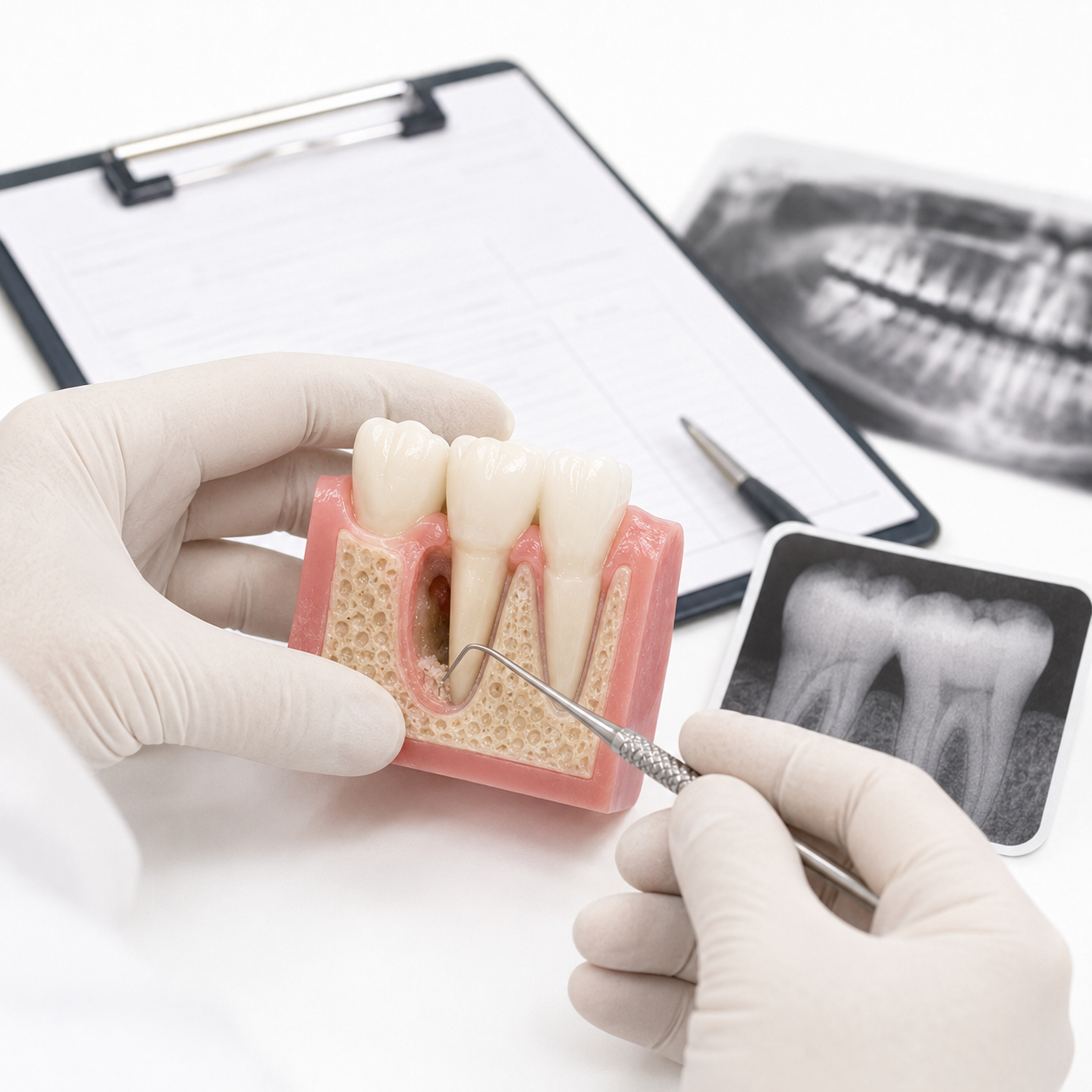
These results come from one defined DPSC product and protocol. The stage III efficacy comparison was post hoc, so it is useful for hypothesis generation but should not be presented as a guaranteed response for another patient or another cell product.[2]
Autologous adipose-derived cells plus PRP were compared with enamel matrix derivative.
The multicenter randomized open-label trial measured outcomes through 36 weeks. New alveolar-bone height was significantly greater in the ASC plus PRP group at 36 weeks. Clinical attachment improved from baseline in the ASC plus PRP group, but the between-group difference in clinical attachment gain was not significant.[3]
Periodontal and imaging outcomes were assessed repeatedly, not after one immediate post-procedure visit.
The bone-height signal should not be rewritten as a proven overall clinical superiority.
The small completed sample is a major limitation when judging how precisely the result predicts outcomes for other patients.
Reported events in the ASC plus PRP group were judged unrelated to the implantation site or treatment.
Stem cells should not skip the steps that control active periodontitis.
The EFP pathway sets measurable endpoints before maintenance: no pocket at least 5 mm deep that still bleeds on probing, and no deep pocket at least 6 mm. If those endpoints are not reached, further non-surgical or surgical treatment is considered according to the residual site.[4]
Control plaque and risk factors
Home care, professional supragingival cleaning, smoking support and relevant medical risk-factor management come first.
Treat below the gum line
Professional subgingival instrumentation targets deposits and biofilm around affected root surfaces.
Reassess residual pockets and defects
Further surgery or regeneration is based on what remains after the response to earlier treatment is measured.
Maintain the result
Supportive periodontal care is individualized; EFP recommends intervals of 3 to a maximum of 12 months according to risk.[5]

There is no valid “stem-cell survival rate” for periodontitis.
For periodontal cell studies, the main outcomes are attachment, pocket depth and bone changes. Long-term tooth retention is more useful to patients, but current cell trials do not yet provide a validated 5- or 10-year tooth-survival rate.
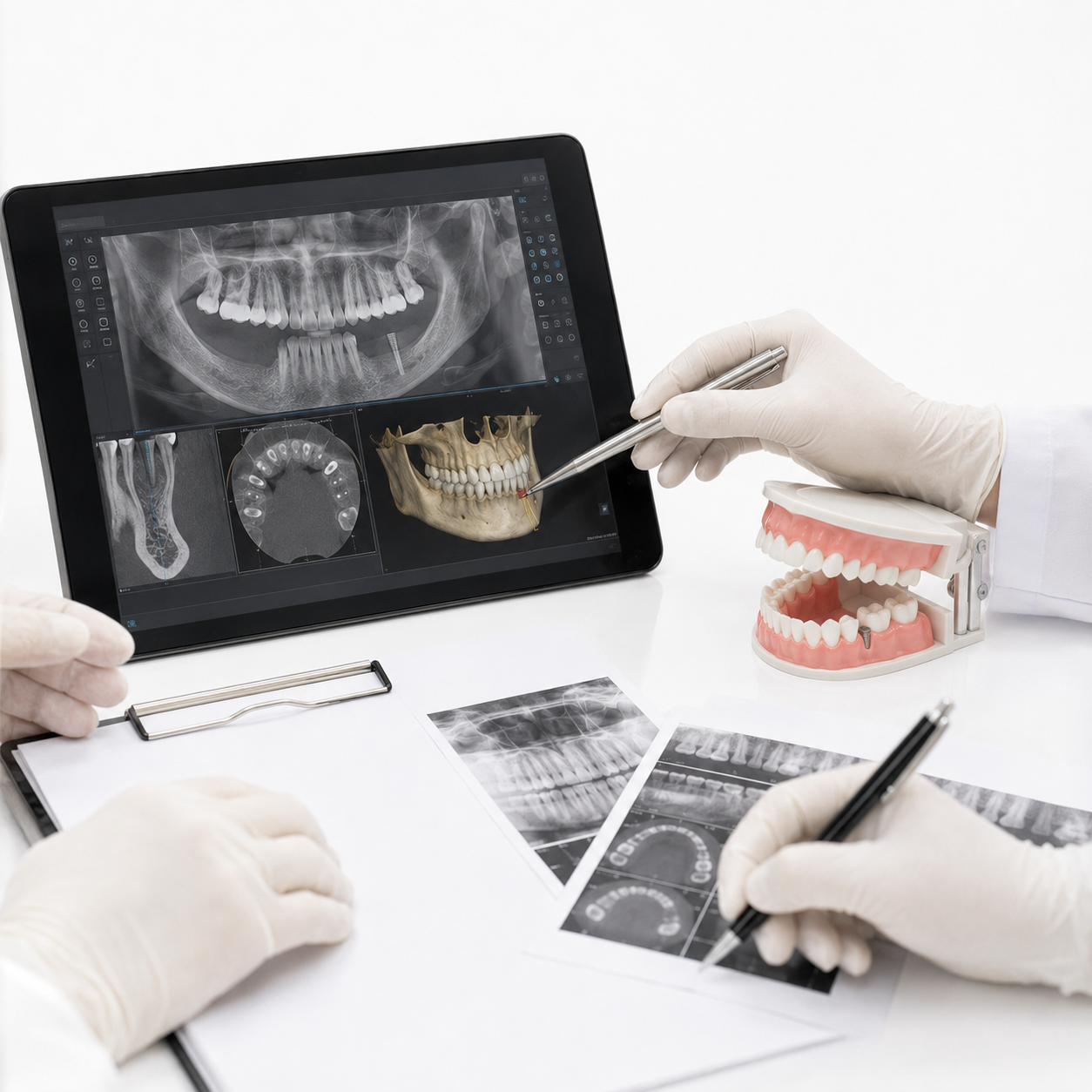
Do not confuse research follow-up with day-to-day recovery time.
The cited cell trials measured effectiveness at six months or through 36 weeks; they do not establish one universal return-to-work or symptom-recovery time. Recovery depends on whether your plan involves injection only, periodontal flap surgery, grafting, or adipose-tissue collection.
Ask for the exact steps in writing: injection site, flap surgery, graft or membrane use, cell-collection site, medication, eating restrictions and planned wound checks.
The 2025 DPSC trial used six-month outcomes for clinical attachment, probing depth and bone-defect measurements.[2]
The 2026 Japan ASC plus PRP trial measured periodontal and imaging outcomes at 12, 24 and 36 weeks.[3]
Supportive periodontal care continues after active treatment; recommended recall intervals are individualized from 3 to 12 months.[5]
Have a quote you cannot compare clearly?
Send the scope, cell source, number of procedures and follow-up terms you were given.
There is no reliable single price for stem-cell periodontitis treatment.
The clinical trials cited here report outcomes, not a validated self-pay price. Human periodontal cell protocols are not standardized, so any commercial quote is provider- and protocol-specific and should be itemized before it is compared.
Turn a complex proposal into a decision you can understand.
We work from your records and the specific protocol you’re considering. The goal is a set of clear questions and comparisons before you commit to anything.
Information and coordination support only. We don’t diagnose periodontitis, choose procedures, prescribe treatment, provide cells or perform dental care.
Evidence match
We compare the claim you received with published human evidence for the same cell source, delivery route, periodontal outcome and follow-up period.
Proposal breakdown
We organize the cell source, dose, number of procedures, biomaterials, monitoring, follow-up and quoted items into a comparison-ready summary.
Record preparation
We help organize periodontal charts, dental imaging, treatment history and relevant medical information so a licensed professional can review the case efficiently.
Cross-border coordination
When requested, we help prepare questions, organize communication and clarify documents across languages and time zones.
Six items make the discussion much more specific.
A legal pathway, a clinical study and an approved product are not the same status.
Ask which framework applies to the exact cell intervention you are considering and verify it against the relevant regulator or registry.
Japan
Japan regulates regenerative-medicine procedures and regenerative medical products through different frameworks. The PMDA publishes approved regenerative medical products and review information, while MHLW publishes information on regenerative-medicine provision plans. A provision plan should not be described as PMDA marketing approval.[9]
Check PMDA approved productsProduct approval is indication-specific
The FDA approved Ryoncil, an allogeneic bone-marrow-derived MSC therapy, in December 2024 for steroid-refractory acute graft-versus-host disease in pediatric patients. That approval does not establish safety or effectiveness for periodontitis. Cell-product evidence must match the actual indication.[8]
Check FDA cellular and gene therapy productsRelated guides for the next decision.
Answers worth having before you commit.
Is stem-cell therapy already a standard periodontitis treatment?
No. Human evidence is growing, but protocols remain variable and long-term evidence is limited. Standard disease control and established regenerative surgery remain the clinical foundation.[4]
What does a 0.75 mm clinical-attachment benefit actually mean?
It is an average difference in a periodontal support measurement, not 0.75 mm of guaranteed new bone and not a tooth-survival rate. The same 2026 meta-analysis found a separate average intrabony-defect difference of 1.09 mm and no statistically significant gingival-recession benefit.[1]
What chart numbers tell me whether more treatment is needed?
Under the EFP stage I–III pathway, treatment endpoints include no pocket at least 5 mm with bleeding and no pocket at least 6 mm. A residual deep pocket with an intrabony defect at least 3 mm deep is an established indication for periodontal regenerative surgery.[4]
What is the success rate?
There is no validated universal percentage for periodontal stem-cell treatment. Ask which endpoint is being called “success,” at what time point, and against which comparator. Current cell studies mainly report pocket depth, attachment and imaging changes over months, not proven 5- or 10-year tooth retention.
Does “zero serious adverse events” prove the treatment is safe?
No. The 2025 DPSC study reported no serious adverse events among 132 participants and only grade-1 treatment-related events that resolved without intervention, but a six-month trial cannot establish every uncommon or long-term risk.[2]
I have stage IV periodontitis. Is this evidence enough for me?
No. Stage IV has a separate multidisciplinary guideline because tooth loss and problems with mastication may require coordinated care involving periodontists and other dental specialists. Cell-study results should be interpreted only after the full stage IV treatment problem is defined.[12]
I have diabetes, heart disease or I smoke. Do the 2025 trial results apply to me?
Not automatically. The 2025 DPSC trial excluded several systemic conditions, including diabetes, cancer and heart disease, and excluded current smoking above 10 cigarettes per day. Those criteria describe the study population; they do not by themselves decide your eligibility. A clinician needs to assess your periodontal condition and medical history before any comparison is meaningful.[2]
What should make me cautious about an offer?
Guaranteed bone regrowth, a fixed success rate before your records are reviewed, unclear cell source or dose, no disease-control plan, no itemized cost, no adverse-event plan, or wording that confuses registration with product approval should all prompt more questions.
Primary guidance and clinical evidence
Send the records and proposal you already have.
We’ll help you organize the evidence, questions, scope and cost items — so you can see what’s known, what’s uncertain and what still needs verification.
Information and coordination support only. This doesn’t replace diagnosis, periodontal examination, informed consent or treatment by a licensed healthcare professional.