
What you should know before choosing NK therapy here
NK Cell Therapy in Japan
If you’re researching NK-cell therapy, the real question isn’t where it’s offered — it’s what the data actually say. We walk through the evidence, how Japan regulates it, what self-pay really costs, the safety picture, and the records you’ll want handy before comparing any proposal against your current cancer care.
Don’t confuse NK therapy with other cell treatments
NK cell therapy is immune-cell therapy
These terms should not be used as if they mean the same thing.
Natural killer cells are lymphocytes used as effector cells in cancer immunotherapy. PMDA guidance lists NK cells separately from mesenchymal stem cells.1
Expanded autologous NK cells
A person’s blood can be collected, NK cells expanded and activated outside the body, quality checked, then returned by intravenous infusion. The exact culture method, cell count and schedule vary by plan.
CAR-NK is a different technology
Genetically engineered NK products have different manufacturing, trial designs and long-term questions. Results from CAR-NK studies should not be used to advertise a non-engineered NK infusion.
Checkpoint inhibitors are also different
Drugs such as PD-1 or PD-L1 inhibitors change immune signaling. Their approved indications and survival data cannot be transferred to an NK-cell protocol.
How Japan actually regulates this treatment
“Available in Japan” is not one regulatory status.
Before looking at testimonials or cell counts, identify the exact route under which the proposed intervention is being offered.
PMDA’s current cell and gene therapy list shows 23 approved products, with two additional expired or withdrawn entries. Six current products are in oncology: five CAR-T products and one oncolytic virus. No NK-cell product appears on that approved CGT list.6
A commercial regenerative medical product is reviewed for a defined product and indication. Approval of CAR-T or another cellular product does not automatically apply to a different NK preparation.
Processed-cell interventions may be provided under Japan’s Act on the Safety of Regenerative Medicine. A public 2026 consent document states that filing its plan does not mean MHLW approved that intervention’s safety or effectiveness.2
A study should identify its protocol, eligibility rules, endpoints, enrolment target, status and adverse-event reporting. Registration shows that a study exists; it does not prove clinical benefit.
Practical check: ask for the plan or trial identifier, exact cell source, whether cells are autologous or allogeneic, and the document that explains the intended use.
What the solid-tumor studies actually found
What the clinical data actually show.
A 2024 systematic review included 31 trials and 600 patients with solid tumors. The pooled ORR/DCR table used data from 591 patients. Nineteen of the 31 trials combined NK cells with another anticancer treatment, so the overall response number is not an NK-alone success rate.3
12 studies / 176 patients: ORR 12.4% (95% CI 7.8–19.0%) and DCR 40.6% (27.6–55.0%). This is the most relevant pooled subgroup when someone is shown an NK-only offer, but the products and cancers still differed.
12 studies / 135 patients: ORR 21.7% (12.1–35.9%) and DCR 56.1% (44.2–67.4%). These studies were not one standardized Japanese self-pay product.
7 studies / 178 patients: ORR 31.8% (19.0–48.1%) and DCR 76.0% (65.3–84.3%). Protocols and companion treatments varied, with high between-study variation for ORR.
3 studies / 49 patients: ORR 72.3% and DCR 88.9%. All three used local or arterial anticancer treatment with NK cells, so these figures should not be presented as NK monotherapy results.
The review detected publication bias for ORR and substantial between-study variation (I² 77.2% for overall ORR). Use these figures to understand the research range, not as a personal success rate or a promise of longer survival.
Making sense of response rates and what they don’t measure
Why there is no single NK-cell survival rate.
The 2024 review pooled tumor-response data across different cancers and protocols; it did not produce one survival number that can be applied to every patient. Survival needs a study that matches your cancer, stage, previous care and exact NK protocol.3
28.2% overall in the pooled analysis means complete or partial tumor shrinkage. It does not mean 28.2% were cured or lived longer.
63.2% overall includes stable disease. Stability can matter clinically, but it is not the same as tumor shrinkage and does not prove a survival benefit.
In the Japanese phase I digestive-cancer study, tumor response was checked by CT using RECIST 1.1 at baseline and every 4 weeks after the final treatment.4
One 2026 public Japanese plan specifies review every 30 days through 6 months after treatment, including general condition, symptoms, biochemical tests, peripheral-blood NK count and NK-function-related cytokines. That schedule is plan-specific, not a universal standard.2
Ask for OS or progression-free survival from a study that matches the disease and protocol. If only cell counts, immune activity or testimonials are shown, the survival question is still unanswered.
Real-world results, grouped by cancer type
What has actually been reported in patients.
Here are the study numbers in context. They only help when you line up the cancer type, cell source and any companion treatments right next to the result.
Phase I autologous NK study: 14 enrolled; 12 received at least two infusions and 10 were per-protocol evaluable. Doses were 0.5, 1.0 or 2.0 billion cells per infusion on days 0, 7 and 14. No tumor shrinkage was seen; 5/10 evaluable patients had stable disease and 5/10 progressed. No severe or unexpected toxicity was attributed to NK infusion.4
Phase I · safety first12 studies / 135 patients in the 2024 review: pooled ORR 21.7% and DCR 56.1%. Different cancers, schedules and companion treatments were included.3
Mixed protocols7 studies / 178 patients: pooled ORR 31.8% and DCR 76.0%. The studies used different NK sources and several combined NK cells with other anticancer treatment, so this is not a stand-alone NK rate.3
7 studies3 studies / 49 patients: pooled ORR 72.3% and DCR 88.9%. Every HCC trial in the review used local or arterial treatment with NK cells, so the high figure cannot be transferred to NK-only treatment.3
Combination data21 studies / 364 patients outside the HCC and NSCLC subgroups: pooled ORR 18.8% and DCR 53.3%. Breast, ovarian, pancreatic, renal, CNS, digestive and mixed solid tumors were represented, mostly in small studies.3
Broad subgroupHave reports, scans and treatment history but no clear way to compare them?
We can organize the records, map your questions to public Japanese sources and prepare a cleaner information set for the next discussion.
What needs individual review
Can this be considered in my situation?
No website can decide suitability. The useful first step is to identify the facts that can change risk, timing or whether the question should be raised at all.
Diagnosis and pathology
Exact cancer type, pathology report, molecular findings when relevant, and date of diagnosis.
Stage and current burden
Latest CT, MRI or PET report, metastatic sites, recent progression and measurable lesions.
Previous and current care
Surgery, radiation, chemotherapy, targeted drugs, checkpoint inhibitors and trials — with exact drug names and dates, especially recent immune treatment.
General condition
Performance status, blood counts, organ function, active infection and symptoms that may need urgent attention.
Plan-specific exclusions
One 2026 public plan excludes HIV- or HTLV-1-positive patients, T/NK-cell lymphoma or leukemia, and prior allogeneic transplant. Interstitial lung disease, active autoimmune disease, pregnancy, possible pregnancy or breastfeeding may also make treatment unsuitable in that plan.5
Standard-care timing
An experimental or non-standard option should not delay an established treatment without agreement from the team responsible for your cancer care.
One public Japanese workflow
What one self-pay autologous NK plan can involve.
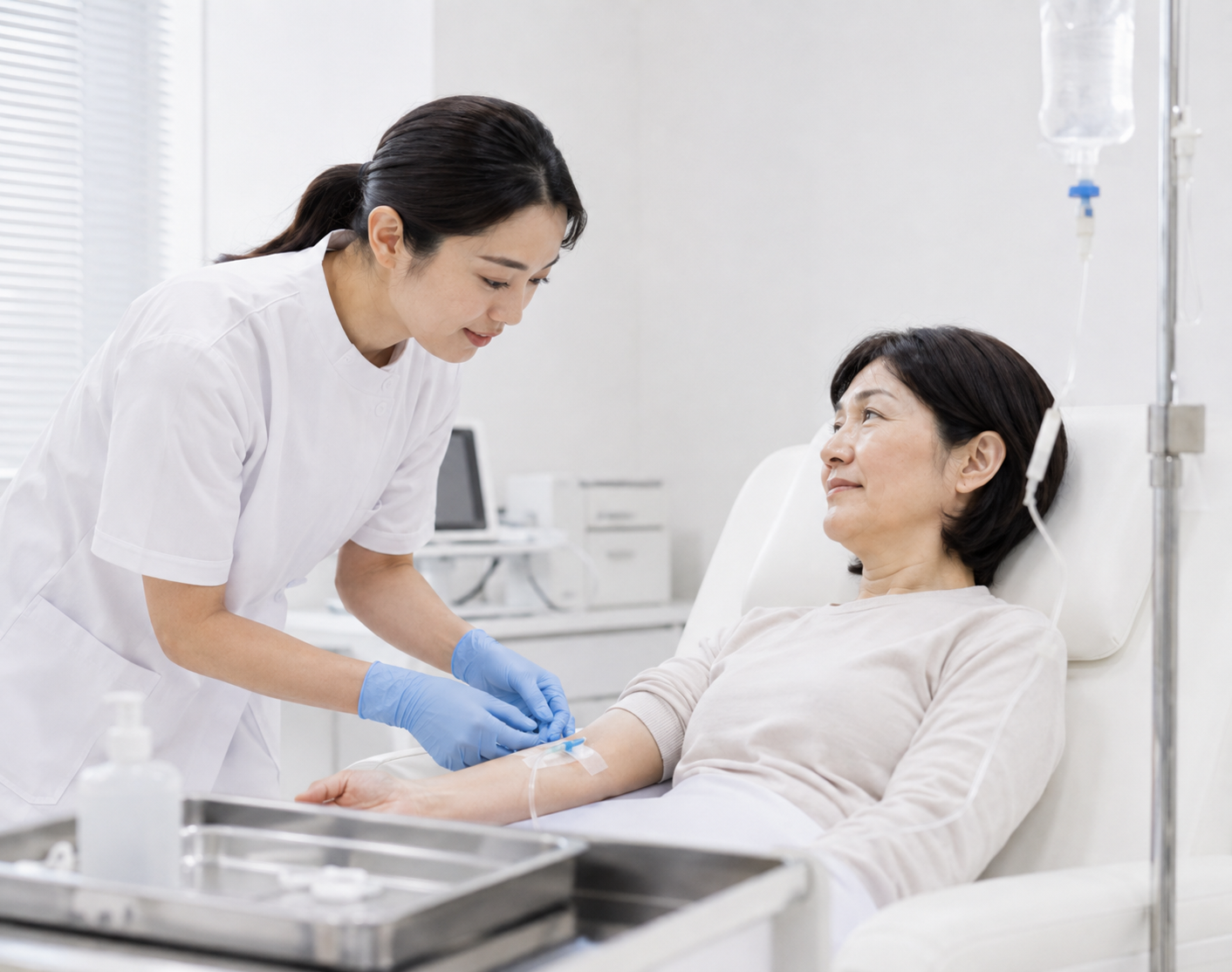
A 2026 public patient document describes about 72 mL of blood for one administration, roughly three weeks of cell preparation, no gene modification in that plan, intravenous administration and later review. The number and interval of administrations depend on the patient’s condition in that specific plan.5
Record review
Diagnosis, current disease status, medicines, recent tests and factors that can change risk.
About 72 mL blood
That is the stated collection volume per administration in this public plan.
About 3 weeks
Cells are prepared under the plan’s defined process. Actual timing can change.
IV administration
The prepared cells are delivered intravenously if patient and product checks allow.
Follow-up
Symptoms, tests and disease status are reviewed before deciding what comes next.
Important for travel planning: the same document says cell yield and condition can vary. A failed quality check, extra testing or transport disruption can delay administration and may require another blood draw. It also states that the final sterility-test result is available after administration in that specific process.5
What the safety studies actually report
What the safety data do and do not show.
The 2024 review found graded adverse-event data in 15 of 31 studies, covering 218 participants. Because many trials used other anticancer treatment, pooled event rates should not be assigned to one NK product or to NK cells alone.3
Across those 15 studies / 218 participants, fatigue was reported at 44%, nausea 37% and anemia 33% in the review’s pooled analysis.
The same pooled analysis reported headache 25%, anorexia 8% and neutropenia 7%. Nineteen of the 31 trials used other anticancer treatments, so these rates do not establish that NK cells alone caused the events.
No cytokine release syndrome or graft-versus-host disease was reported in the studies included in that meta-analysis. This is reassuring study-level information, not proof that every NK product has zero risk.
A 2026 public Japanese consent document states that safety of near-same-time immune-cell therapy and checkpoint inhibitors is not established and describes serious reported events with uncertain causality. Keep the exact drug name and administration date available.2
Breathing difficulty, chest pain, fainting, severe confusion, rapidly spreading rash or persistent high fever need urgent local medical assessment rather than an online reply.
Real prices from public plan documents
What might it cost?
There is no national NK-cell price. Two public 2026 Japanese plan documents reviewed here list different per-administration fees, and both state that the intervention is self-pay rather than covered by Japanese public health insurance.
¥650k
The reviewed plans state that these interventions are outside Japanese public health-insurance coverage and are paid privately.
One 2026 public example lists an initial consultation fee of ¥22,000 and notes that additional tests can add cost.
The ¥430,000 example says processing costs remain payable once cell processing has started, and tests are charged separately. The ¥650,000 example states that costs already incurred before consent withdrawal can still be charged.52
For an international patient, flights, accommodation, translation and repeat visits can materially change the full budget.
Questions to ask before you hand over any money
Ask for the product details, not just a cell count.
“Billions of NK cells” is not enough information to compare two options. Manufacturing and follow-up details can be just as important.
Autologous or allogeneic source, engineered or non-engineered, and the intended cell population.
Collection method, culture duration, activation method, fresh or frozen status and the facility responsible for processing.
Ask which tests define identity, viability, cell number and contamination control, when each result becomes available, and what happens if a result fails. One 2026 public plan states that its final sterility result becomes available after administration.5
Cells per administration, number and interval of administrations, companion therapy, and conditions that cause delay or cancellation.
Ask what counts as benefit, when CT/MRI is repeated, which response criteria are used, and the rule for continuing or stopping. Immune-cell counts alone do not show that a tumor has responded.
Eight things to put on paper before deciding
Eight items worth having in writing.
These questions make it easier to compare offers without relying on sales claims.

What Japan Medical can do
Patient Information Review and Coordination
Send the records you already have. We turn them into a structured case summary, a source-based question list and a practical Japan checklist so you can compare options without relying on sales claims.
Structured case summary
Diagnosis, pathology, stage, imaging dates, previous treatment, current medicines, recent laboratory results and an easy-to-read treatment timeline.
Evidence and status check
Match the proposed cell type and intended use to public Japanese regulatory information and published human evidence, with the main limitations kept beside the numbers.
Japan coordination checklist
Prepare document requests, translation needs, appointment questions, timing, expected visits, cost items and travel steps once the medical information is clear.
Japan Medical provides information review and coordination support. We don’t diagnose, prescribe, or decide eligibility — and we can’t replace your treating physician or guarantee an outcome.
Where to read next
Useful next reads on Japan Medical
Questions patients usually ask
NK Cell Therapy in Japan FAQ
Is NK cell therapy approved in Japan?
Do not use “available in Japan” as a synonym for product approval. PMDA’s approved CGT list dated March 16, 2026 shows 23 current products; six are oncology products, including five CAR-T products and one oncolytic virus, and no NK-cell product appears on that list. A separate ASRM treatment plan can be filed without being a PMD Act-approved product.
What is the success or survival rate?
There is no validated universal rate. The 2024 solid-tumor review reported overall pooled ORR 28.2% and DCR 63.2% across varied protocols. In the subgroup without other anticancer treatment, ORR was 12.4% and DCR 40.6%. These are response data, not a personal survival prediction.
What has been reported with autologous NK cells?
In the 2024 review, 12 autologous-NK studies with 135 patients had pooled ORR 21.7% and DCR 56.1%. A separate Japanese phase I study in advanced digestive cancer found no objective tumor responses in 10 per-protocol patients; five had stable disease.
How much can NK cell therapy cost in Japan?
Two public 2026 plan examples reviewed here list ¥430,000 and ¥650,000 per administration. Both are self-pay examples, not a national price. One also lists a ¥22,000 initial consultation, while testing, cancellation, repeat visits and travel can add cost.
How long can cell preparation take?
One public 2026 autologous NK plan states that about 72 mL of blood is collected for one administration and cell preparation takes about three weeks. The same document warns that quality checks, extra testing or transport problems can cause delay or require another blood draw. Other plans can differ.
How should I know whether it is working?
Ask for a defined imaging and follow-up plan. In the Japanese phase I digestive-cancer study, CT was assessed with RECIST 1.1 at baseline and every four weeks after the final treatment. Changes in NK-cell counts or laboratory immune activity alone do not prove that a tumor has responded.
Can it replace surgery, radiation or systemic therapy?
This information does not support delaying or replacing an established option. Any non-standard intervention should be discussed with the team responsible for your cancer care, especially when surgery, radiation, chemotherapy, targeted therapy or approved immunotherapy remains indicated.
Where these numbers and facts actually come from
Numbers are kept next to their source and limitation.
Public regulatory documents and peer-reviewed research are used for the factual points above. Provider marketing claims are not used as evidence of effectiveness.
We last checked these sources on August 11, 2026. Medical evidence and Japanese public filings can change — so re-check the exact plan or product before you decide.

Here to help coordinate, not to prescribe
Turn scattered records into a clear next step.
Send us your pathology or diagnosis, your latest imaging, a treatment timeline, current meds, recent labs, and whatever questions you’re carrying. We’ll organize it all, line it up against the relevant public evidence, and pull together a practical checklist so you know what comes next.
WhatsApp: +81-8070161366
LINE: +81-8075357788
Information review and coordination support can’t replace a proper diagnosis, prescribing, emergency care or the judgment of your treating physician.